There is a particular kind of feeling alone that can show up during the holidays. It can appear when you are surrounded by people, expectations, and noise—or when you are all by yourself. It’s the kind of loneliness that makes you wonder why this season feels heavier for you than it seems to be for people around you.
If Christmas doesn’t feel warm or joyful, if your body feels tense, tired, or on edge while the world around you is celebrating, there is nothing wrong with you. You are not failing at the holidays. For many people, this time of year is not peaceful at all—it can stir old memories, trauma, unspoken grief, complicated relationships, and emotions that don’t fit into festive traditions.
If you feel alone in this— now or on other days—this text is for you.
For a lot of people, Christmas and the holiday season come with pressure. Pressure for things to be a certain way, for family and relationships to feel harmonious, and for emotions to match the expectations of joy and gratitude. We are often subtly or directly reminded: “It’s Christmas, you should be happy.”
But for many, these expectations create the opposite effect. The more we try to suppress what we are actually feeling—sadness, anger, disappointment, exhaustion, or grief—the more inner tension builds. When we push down what has happened in our lives before the holidays—losses, conflicts, unmet needs, difficult experiences, trauma —confusion and irritation often rise instead. This can show up as emotional distance and silence, or as arguments and intense reactions that feel sudden or out of place.
When trauma comes into play, the holidays can be especially challenging. Certain smells, sounds, family dynamics, people or traditions can activate old memories stored not just in the mind, but in the body. A look, a comment, or the expectation to “act normal” can trigger feelings of fear, shame, helplessness, or deep sadness. These reactions may seem disproportionate to the situation, yet they are very real. Trauma does not pause because it is Christmas, often it gets even intensified by the fact that it is these holidays.
For many people with trauma, the nervous system remains on high alert during this time of year. This can lead to feeling emotionally numb, overwhelmed, disconnected, or suddenly exhausted. Others might find themselves over-functioning—trying to keep everyone comfortable, holding things together, performing happiness while feeling empty inside. None of this means you are weak or broken. It means your system is trying to protect you based on what it has learned in the past.
It is no coincidence that the highest number of break-ups happens in January. When people are expected or even forced to feel loving, connected, or grateful simply because it’s the holiday season, the underlying truth of relationships often becomes clearer afterward. The holidays can magnify what already exists: distance, unresolved conflict, unmet emotional needs, or patterns built around survival rather than connection.
What we suppress does not disappear. It waits. And often it returns with more strength. Problems that are pushed aside do not dissolve—they gather reinforcements. Eventually, our reality reflects what we have tried to avoid for a long time. The longer we force ourselves to feel a certain way while our inner experience tells a different story, the more this tension pushes back—emotionally and physically. If we don’t listen to ourselves and learn to set boundaries, our bodies often step in through exhaustion, illness, anxiety, or shutdown. If we don’t learn to say no, our body will eventually say no for us.
And yet, there is another possibility.
Maybe this holiday season does not have to be about forcing joy or pretending everything is fine. Maybe it can be a season where you start listening to yourself more honestly. Where you protect your energy, honor your limits, and allow yourself moments of rest. This might look like stepping outside during a gathering, leaving earlier than planned, creating new traditions, or simply choosing quiet over obligation.
I know this can feel very lonely. You might feel like you don’t belong, like everyone else has access to something you don’t. You might feel isolated in your experience, as if no one would understand what is happening inside you. But this feeling, as convincing as it is, is not the whole truth.
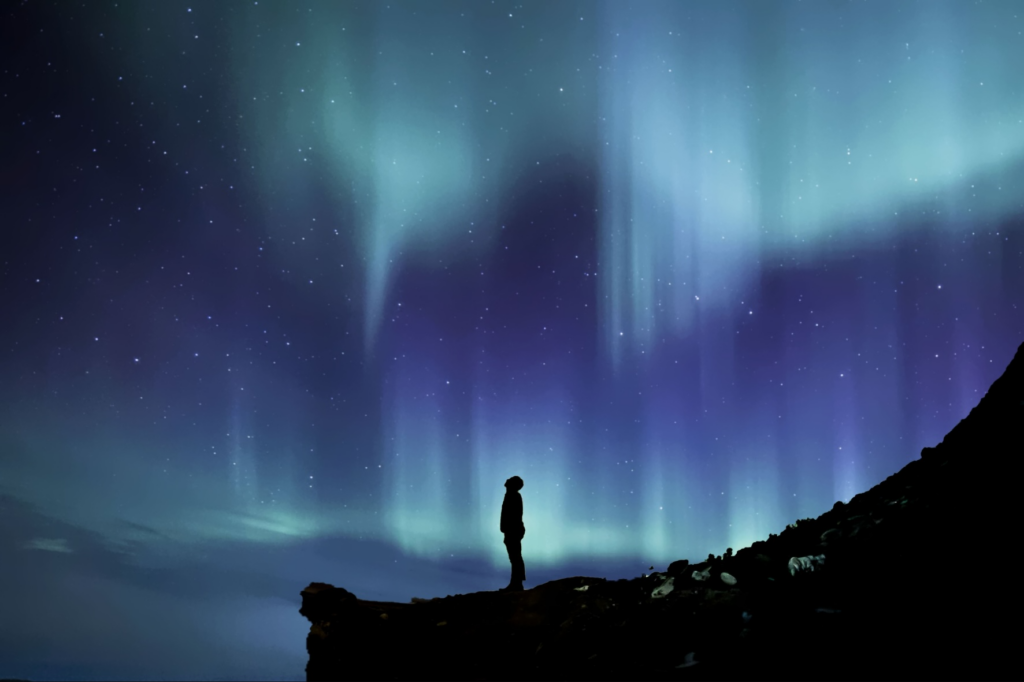
Like the image I chose for this article, you may not immediately see others walking a similar path. At first glance, it can look like you are standing alone in the dark. But just like stars in the night sky, there are others out there—close by, sharing similar struggles, even if you cannot see them right now. We exist together in this vast universe, connected in ways that are not always visible.
There are people who face the same challenges you do—people who know what it feels like to feel lost, overwhelmed, triggered, or stuck. They understand darkness, despair, and the fear that things may never change. And still, they are here. Breathing. Continuing. Taking one step at a time.
For all of you who feel this way: you are not broken. Your reactions make sense. Your sensitivity has meaning. And, especially in this season, you are not alone.
And since truth has to enter not only the mind, but also the heart, the soul and the body, I found a magical gift from Dami Charf for you. She has written a beautiful song that couldn’t describe any better what I want you to know.
Here is her song – may it show you that you are not alone. That there are many of us. And that we were NEVER MEANT to be alone.
May this season be a step for you towards yourself, to your being and to your authenticity.
I wish you the best and I am glad you are here 💛.
PS: For all my German speaking people – here is the link to Dami Charf’s Website